
Halved growth, deeper concentration
Aave V3 was the only major DeFi lending protocol on Ethereum that grew in July. Its net constant-price deposit flow was +$649M. The other five covered protocols (SparkLend, Morpho V1, Fluid, Compound V3, Euler V2) combined for a net −$96M in the same window. The sector's aggregate +$553M inflow was Aave V3, with a small amount left over. Without Aave, the sector would have contracted.
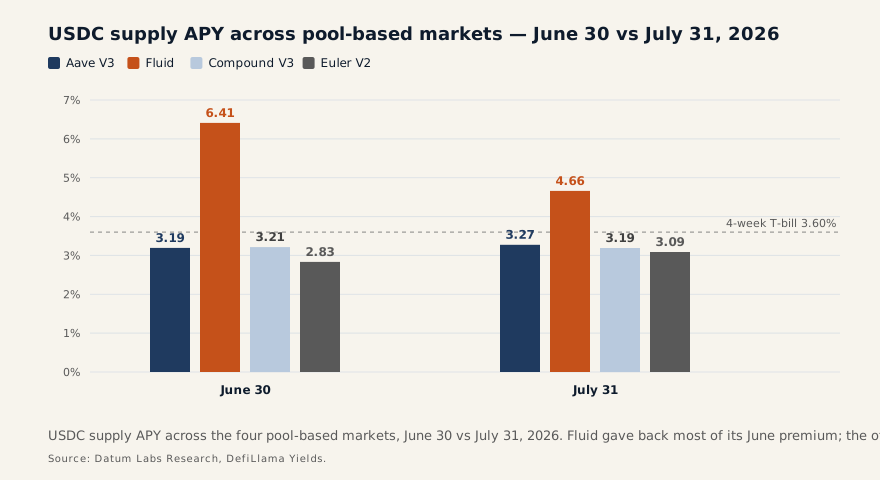
That is the shape of a depositor market running out of participants. July halved June's aggregate growth (from +$1.33B to +$553M) while curator concentration on the Morpho vault surface climbed for the second consecutive month (HHI 2,095 → 2,337), and the sector's real yield on stablecoin supply deepened to −75 bps below the 4-week T-bill (from −37 bps at the June close). Fluid's June rate leadership on USDC (the sector's only positive real-yield spread over T-bill at the June close) narrowed from +281 bps to +106 bps as its USDC supply APY fell from 6.41% to 4.66%.
Aave grew on collateral, not on its base stablecoin supply
Aave V3's inflow arrived in the assets people post to borrow against, not in the assets people lend to earn a supply rate. USDC on the protocol shed $20M in July, a smaller drain than June's −$162M but the same direction. USDT shed $62M and WETH shed $29M. Against those, the volatile collateral reserves grew: weETH +$285M, WBTC +$124M, wstETH +$113M, cbBTC +$63M. Alongside them, sUSDe grew +$145M. sUSDe is a stablecoin by asset class, but on Aave it functions as collateral for Ethena carry trades rather than as lending supply. This is the second consecutive month of the same composition: collateral in, base stablecoins and ETH flat to negative. Aave V3's growth this cycle reflects depositors supplying collateral to borrow against, not lenders chasing the 3.27% USDC supply rate that sits 33 bps under the T-bill.
Curator concentration continued climbing
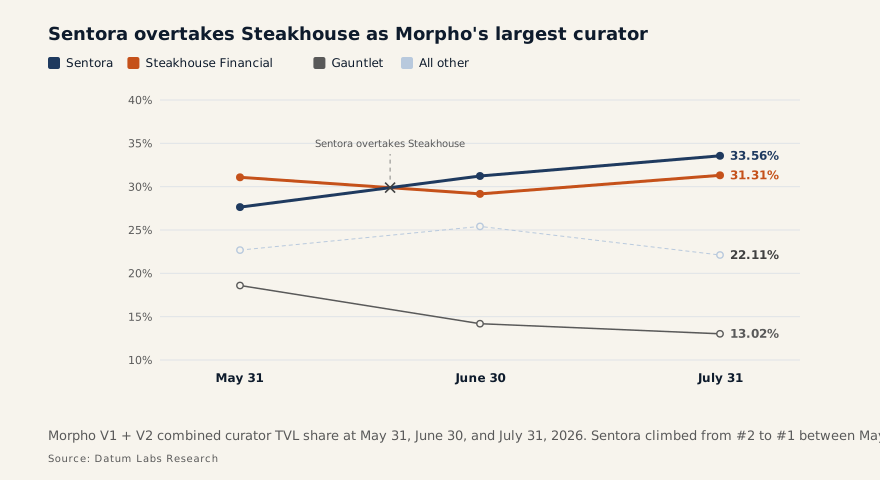
Morpho V1 + V2 combined curator concentration read HHI 2,337 at the July 31 close, up from 2,095 at June 30 (+242 index points, +11.6%). Top-three curator share moved from 74.6% to 77.9% (+3.3 pp). Underneath that aggregate view, the composition rotated. Sentora grew from 27.65% at May 31 to 33.56% at July 31, overtaking Steakhouse Financial to become the largest single curator on the Morpho vault surface. Steakhouse held roughly flat across the two months (31.08% → 31.31%). Gauntlet declined for the second consecutive month, from 18.59% to 13.02%. The "concentration climbing" story is really "Sentora rising, Gauntlet declining, Steakhouse steady."
Real Yield Spread deepened
The sector's blended stablecoin supply APY minus the 4-week T-bill closed July at −75 bps, down from −37 bps at June 30. Real yield on stablecoin supply worsened relative to T-bills by 38 bps across the month. The mechanism is the same as June: soft stablecoin borrow demand while T-bill rates held around 3.60%.
Fluid's USDC supply APY fell from 6.41% at June 30 to 4.66% at July 31. Fluid still leads the sector on USDC supply, but the gap to Aave V3 (3.27%) narrowed from 322 bps to 139 bps. Fluid was the sector's only positive real-yield spread over T-bill at the June close (+281 bps); at the July close it sits at +106 bps above the T-bill, still the only covered venue paying above it.
The sector's borrow book barely moved
Sector loan-to-deposit ratio at July 31 was 40.63%, essentially unchanged from June's 40.99% (−36 bps). Borrow book utilization is not the July story. The July story is on the depositor side and the curator layer: growth halved, concentration climbed, real yield deepened, and one protocol absorbed almost all of what growth remained.
By the numbers
Snapshot date: July 31, 2026, 23:59 UTC. All month-over-month comparisons against June 30, 2026.
Net constant-price deposit flow, July
| Protocol | Net flow (July) |
|---|---|
| Aave V3 | +$649M |
| Morpho V1 | +$135M |
| Fluid | +$26M |
| Compound V3 | −$23M |
| Euler V2 | −$31M |
| SparkLend | −$203M |
| Sector total | +$553M |
Balance sheet by protocol, July 31
| Protocol | Available liquidity | Borrow book | LDR |
|---|---|---|---|
| Aave V3 | $11.44B | $8.85B | 43.63% |
| SparkLend | $3.76B | $1.81B | 32.53% |
| Compound V3 | $908M | $460M | 33.48% |
| Fluid | $464M | $571M | 55.19% |
| Euler V2 | $99M | $308M | 74.86% |
| Morpho (V1 + V2 curated) | $2.21B | — | — |
USDC supply APY across the pool-based markets, July 31
| Protocol | USDC supply APY |
|---|---|
| Fluid | 4.66% |
| Aave V3 | 3.27% |
| Compound V3 | 3.19% |
| Euler V2 | 3.09% |
SparkLend's USDC supply APY (3.47%) comes off a utilization curve whose base rate is Sky-anchored (set by Sky governance, not fixed at listing), so it responds to both utilization and Sky moves and is not a clean like-for-like against the four pool-based markets above.
Rate compression across the sector
Fluid held the sector's only positive real-yield spread on USDC at the June close, paying depositors 281 bps above the 4-week T-bill. By July 31 that premium compressed to 106 bps above the T-bill. Fluid gave back more than half its rate lead in a single month while the sector's real-yield deficit deepened by another 38 bps. Stablecoin depositors on DeFi lending markets are being paid less than a T-bill in every pool-based market except Fluid, whose premium over the risk-free rate compressed toward its structural level.
The sector's blended stablecoin supply APY closed July at 2.85%, against a 4-week T-bill of 3.60%. Real Yield Spread: −75 bps. That is deeper than June's −37 bps close and marks two consecutive months of materially negative RYS after May sat close to parity at −0.3 bps.
Fluid's rate leadership narrowed
Fluid's USDC supply APY fell from 6.41% at the June 30 close to 4.66% at July 31, a decline of 175 bps in a month. Aave V3's USDC supply rate moved 8 bps across the same window (3.19% → 3.27%). The Fluid compression was idiosyncratic, not sector-wide. Fluid's lead over Aave V3 narrowed from 322 bps at June 30 to 139 bps at July 31.
What the compression means
Two forces are converging on the sector's stablecoin markets. First, T-bill yields held steady around 3.60% through July, providing a hard floor for any risk-free comparison. Second, stablecoin lending rates across the pool-based markets compressed toward one another and toward that floor. At the June 30 close the spread from top to bottom of the pool-based USDC field was 322 bps (Fluid 6.41% to Aave V3 3.19%). At July 31 it was 157 bps (Fluid 4.66% to Euler V2 3.09%). The dispersion halved.
Issue 003 closed with RYS at −37 bps and framed it as a compression signal. Issue 004 closes with it at −75 bps. Compression is now a trend, not a data point.
Where the July money went
The July flow map has one dominant venue, one clear loser, and four protocols that broadly held or added modest ground. Aave V3 alone accounted for 117% of the sector's net inflow, with the other five protocols combining for −$96M. SparkLend was the largest single-protocol contraction of the month.
Aave V3's composition
Aave V3's July composition mirrored June. USDC contracted by $20M across the month. The remaining +$669M came from collateral inflows across the LRT, BTC-variant, and yield-bearing synthetic-dollar reserves, with the largest additions in weETH (+$285M), sUSDe (+$145M), and WBTC (+$124M). sUSDe is a stablecoin by asset class but functions as Ethena-carry collateral on Aave. The observation from Issue 003 continues to hold: Aave V3's growth mechanism in this cycle is collateral supply attracted by borrow-book depth, not base-stablecoin lenders chasing rates. Two consecutive months of the same pattern is now a trend, not a June anomaly.
SparkLend's outflow
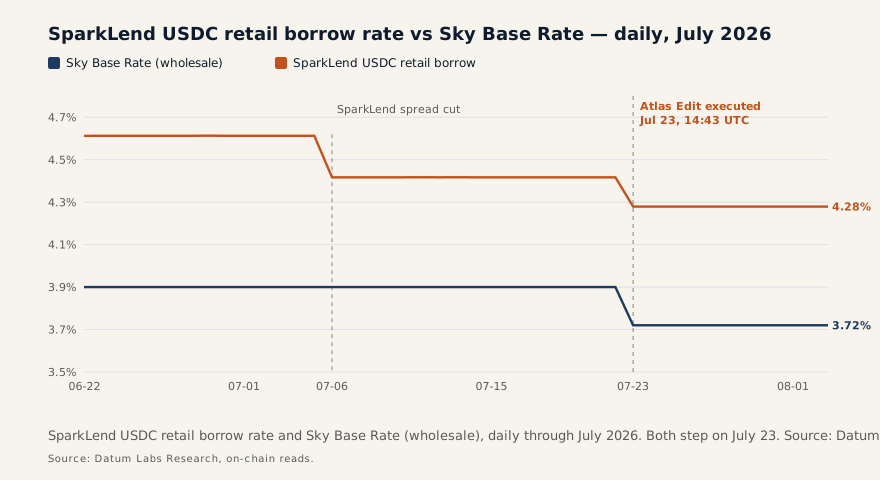
SparkLend's July −$203M net constant-price flow was the sector's largest single-protocol contraction. The month contained two outsized single-day outflows that shape the total: July 12 (−$315M) and July 28 (−$173M). The other 29 days combined for approximately +$285M of offsetting inflows. The July 28 outflow followed the July 23 Atlas Edit spell that cut SparkLend's stablecoin borrow rate by 18 bps. The July 12 outflow does not align with any known Sky governance action.
The mixed middle
Morpho V1 added +$135M despite the curator layer's continued consolidation into V2 vaults through the month. Fluid added +$26M, a near-flat outcome: rate-leadership narrowing did not cause aggregate outflows at the protocol level. Compound V3 and Euler V2 each shed roughly $25M to $30M, modest contractions on protocols with smaller absolute TVL bases. The July flow map is not "everyone shrank." It is one protocol growing large, one shedding material capital, and four broadly holding — more consistent with a sector picking a winner than one broadly leaving.
Per-protocol coverage
Aave V3
Aave V3's July constant-price net deposit flow was +$649M, down from June's +$845M but positive for the second consecutive month — the only major covered protocol to have grown in each of the last two months. Available pool liquidity at July 31: $11.44B; borrow book $8.85B, the deepest in the sector; LDR 43.63%. Net stablecoin position grew by roughly +$145M, but the growth landed in the USDe complex (Ethena's synthetic dollar and its Pendle-tokenised forwards) rather than in USDC or USDT — a different depositor composition than early 2026.
SparkLend
SparkLend's July flow was −$203M, the largest single-protocol contraction of the month. Five of SparkLend's eighteen reserves (all stablecoins) price their borrow rate off a utilization curve whose base rate is anchored to a Sky-linked rate source rather than fixed at listing. All five stepped on July 23, by different amounts, when Sky's weekly Atlas Edit executive spell executed on-chain at 14:43 UTC and cut the Sky Base Rate (the wholesale cost of capital SparkLend pays for its USDS inventory) from 3.90% to 3.72%. SparkLend's on-chain USDC borrow rate followed the same day, stepping from 4.42% to 4.28% as 14 of the 18 bps passed through and the rest widened SparkLend's markup.
SparkLend is a hybrid. Its five Sky-linked stablecoin reserves (DAI, USDC, USDT, USDS, PYUSD) use Aave-shape utilization curves whose base rate is anchored to a Sky-linked rate source Sky governance can move; its thirteen collateral reserves use standard utilization curves with base rates fixed at listing. Comparing Fluid's 4.66% supply APY on USDC to SparkLend's 3.47% is influenced by both pool utilization and, on SparkLend's side, that Sky-governance-set anchor, so SparkLend's rate can shift on days its utilization has not moved in ways the pure-utilization protocols' rates cannot.
Morpho
Morpho's July constant-price net deposit flow was +$135M at the protocol level — the second-highest positive flow among covered protocols after Aave V3, even as the vault surface consolidated into fewer curator hands. Combined V1 + V2 curated TVL at July 31: $2.21 billion, of which V2 accounted for 71.76%. The three largest curators: Sentora (33.56% share, $741M, 3 V2 vaults), Steakhouse Financial (31.31%, $691M, 18 vaults), and Gauntlet (13.02%, $287M, 22 vaults, V1-heavy). Morpho also shipped Midnight, a fixed-rate and fixed-term lending product on Morpho V2, on July 24 — a categorical change for a depositor market, though not observable in July's flow data yet.
Fluid
Fluid's July constant-price net deposit flow was +$26M — essentially flat in a month when its USDC rate leadership narrowed materially. Available pool liquidity at July 31: $464M; borrow book $571M; LDR 55.19%, second only to Euler V2 and well above the pool-based cluster. If Fluid ran on a pure yield-chasing depositor base, a 175-bps rate compression would typically produce a visible outflow. It did not — a data point about depositor stickiness that August will test further.
Compound V3
Compound V3's July flow was −$23M, a modest contraction. Available pool liquidity at July 31: $908M; borrow book $460M; LDR 33.48%. Compound V3's USDC supply APY at July 31 was 3.19%, only 10 bps above the sector's laggard (Euler V2) and 8 bps below Aave V3 — not a rate-competitive position for a protocol that historically led on USDC yields in earlier cycles.
Euler V2
Euler V2's July flow was −$31M, the second-largest single-protocol contraction after SparkLend, on the smallest available-liquidity base among the covered protocols ($99M; borrow book $308M; LDR 74.86%, the highest in the sector). The vault surface is highly concentrated: Sentora runs 72.2% of Euler V2's curated TVL through five vaults, and the combined V1+V2 HHI is 5,512 — materially higher than Morpho's 2,337.
What August tests
Issue 004 documents a sector at half speed. Growth halved from June, concentration on the curator layer climbed for a second consecutive month, the real-yield deficit deepened, and one protocol carried most of the aggregate flow. Whether these are trend prints or one-month artifacts is what August resolves.
- Does one protocol continue to carry the sector? Two consecutive months of Aave-dominant growth (June +$845M, July +$649M) is not a base case for a healthy multi-protocol sector.
- Does curator concentration keep building? A third consecutive month of climbing Morpho HHI hardens the two-curator dominance framing; even a modest reversal reads as "consolidation peaked in July."
- Does the real-yield deficit deepen further? RYS went from −37 bps in June to −75 bps in July. Another 30+ bps deepening in August pushes the deficit toward levels not seen since March.
A month in which Aave V3 goes flat or negative while another protocol absorbs material inflow would falsify the concentration-in-flow trend. Without that, the base case for Issue 005 is: same shape, deeper.
Source: on-chain reads against each protocol's core contracts, DefiLlama, and the U.S. Treasury 4-week T-bill via FRED. Compound V3 and Euler V2 readings substitute on-chain Comet and EVK aggregations for DefiLlama's chain-TVL figures, which over-count both protocols.